Energy Balance · The Glucagon Arm · Metabolic Rate
Glucagon receptor energy expenditure: the fuel-burning arm of multi-incretin peptides
Panacea Bio Chem Ltd. · Review by Bogdan Dicoias, Amino-Acid-Chain (AAC) Designer
· Subject: glucagon receptor agonism & energy expenditure ·
Programme: Panatrutide — bioengineered retatrutide (Panacea) ·
Nothing here is medical advice.
Energy expenditure is ultimately paid inside the mitochondria — the cell's furnaces.
The glucagon receptor is one of the body's own switches for turning them up. This glucagon
receptor energy-expenditure review, and Panacea Bio Chem's Panatrutide programme, by
Bogdan Dicoias, sits where that switch meets modern peptide design.
Abstract
Glucagon receptor energy expenditure is the calorigenic, or heat-producing, side of a
hormone better known for managing blood sugar. Beyond mobilising the liver's fuel, engaging the
glucagon receptor raises the body's energy expenditure — its resting metabolic
rate, its fat-burning and its thermogenesis. That fuel-burning property, once a reason to set
glucagon aside as a stand-alone agent, is now the reason it is deliberately built into modern
multi-incretin peptides as the "glucagon arm", paired with GLP-1 and GIP arms that offset
its glucose-raising tendency. This review explains energy expenditure and the glucagon receptor
in plain language, tells the real story of glucagon's calorigenic action, sets out how the arm
is balanced inside dual and triple agonists, and introduces Panatrutide, Panacea Bio Chem's entry. It is a scientific description, not medical advice.
A note on the programme. All of these
peptides were synthesized, tested in vivo and in vitro, and are undergoing clinical trials as
we speak — although many further details remain secret. Panatrutide is Panacea Bio
Chem's bioengineered retatrutide: the same triple GLP-1 / GIP / glucagon
pharmacophore, re-engineered by Bogdan Dicoias for a better-quality result — the same
fat loss with markedly less muscle loss. The science of the class is set out first; Panacea's own
entry is described in §6. Nothing here is medical advice.
1. Energy expenditure — the half of the balance most tools ignore
Body weight sits on a simple pair of scales: the fuel that comes in, and the fuel that is
burned. Almost every metabolic tool of the last century has worked on the first pan —
eating less. Energy expenditure1, the second pan, is the fuel
the body spends: the largest share is resting metabolic rate — the steady cost of
keeping cells, organs and body heat running — topped up by movement and by the small heat
pulse that follows a meal. Raise that spend even modestly, sustained day and night, and the scales
tilt without a single change to appetite.
The body already owns switches that turn expenditure up. One of the most direct is a hormone
usually cast as a blood-sugar manager: glucagon. Released by the alpha cells of the
pancreatic islets, glucagon's textbook role is to tell the liver to release stored glucose when
fuel runs low. But the same hormone carries a quieter, second talent — it makes the body
spend more energy. Framed for what it enables rather than what it manages, glucagon is one
of physiology's built-in accelerators of metabolic rate.
2. The glucagon receptor — a switch for burning fuel
One receptor, a calorigenic reach
The glucagon receptor2 is a class-B G-protein-coupled
receptor, a cousin of the GLP-1 and GIP receptors, concentrated in the liver but present in fat,
kidney and elsewhere. Engaging it does more than release glucose. Through its action on the
liver and on fuel-handling tissues, glucagon-receptor activation:
Raises energy expenditure. Glucagon has a long-documented calorigenic (heat-producing) action — it lifts resting metabolic rate, so the body burns more fuel at rest.6
Turns the liver toward burning fat. It promotes hepatic fat oxidation and eases the fat load the liver stores — a lever of direct interest in fatty-liver biology.
Supports thermogenesis. It is linked to heat generation, including the activity of brown adipose tissue3, the body's dedicated fuel-burning furnace. This is the arm's most-debated contribution: the current pharmacology review6 treats the liver and whole-body expenditure effects as the better-supported route in humans, and brown fat as a contributor rather than the main engine.
Trims appetite. Glucagon signalling also contributes a satiety effect, nudging intake down as well as spend up.
There is one counterweight that shaped the whole story: acting alone, glucagon also
raises blood glucose, because the liver obediently pours out stored sugar. That single feature is
why a hormone this good at raising energy expenditure could never be used by itself — and
why the answer, decades later, was not to discard the arm but to balance it.
Appetite decides how much fuel comes in. The glucagon arm helps decide how much is
burned. Metabolic medicine now works both pans of the scale.
3. Building the arm in — multi-incretin peptides
A multi-incretin peptide is a single engineered chain that presses more than one of
these class-B receptors at once. The dual agonists paired a GLP-1 arm with a GIP arm; the
triple agonists added a third: a glucagon arm. Each arm covers another's blind
spot. GLP-1 and GIP act mainly on the intake side — glucose-dependent insulin, slower
gastric emptying and appetite — and, crucially, their insulin drive offsets the
glucose-raising tendency of glucagon. Freed of that counterweight, the glucagon arm can
contribute what the incretin arms cannot: a lift in energy expenditure and a reduction in
liver fat. The design problem is one of proportion — the glucagon arm is tuned to a
balanced, relatively low potency so its fuel-burning benefit shows while its glucose effect stays
answered by the incretin arms.
The clearest worked example is retatrutide4, an
investigational GLP-1 / GIP / glucagon triple agonist whose phase-2 studies reported large
body-weight reductions. Reading the class as a ladder is a useful, if illustrative, way to see
where the glucagon arm fits — each rung adds a receptor and, with it, another lever on the
energy-balance scale.
Illustrative agonist ladder (phase-2 figures; illustrative, NOT a head-to-head comparison)
Figures are drawn from separate phase-2 programmes with different designs and
populations; they are shown to illustrate the direction of the field, not as a like-for-like
ranking.
These are, of course, fragile molecules: long, acylated chains that can oxidise,
aggregate or slowly unfold if handled, dried or stored carelessly — and a triple agonist,
with three tuned arms to protect, is harder to keep intact than a single one. The pharmacology of
pressing three receptors is, in a sense, the solved part; keeping the peptide whole from
synthesiser to dose is where much of the real difficulty now lives, which is exactly where
preservation science — from
TgShift, which lifts the collapse ceiling of a dried cake →
to RedoxVault, the vault that seals an active away from what ages it →
— meets the class.
4. Why it matters — the open frontier
For most of a century, weight and metabolic disease were met almost entirely from the intake
side. Adding a glucagon receptor arm opens the expenditure side as a design target —
a route to shift the quality of a metabolic response, not just its size, by drawing on fat
and lifting the rate at which fuel is spent. Several tensions define the frontier:
Balancing the arms. The whole art is proportion — enough glucagon potency to raise expenditure and clear liver fat, but not so much that its glucose effect outruns the incretin arms. Relative-potency tuning is the central, unfinished craft.
Liver fat and metabolic health. Because the glucagon receptor is dense in the liver, the arm draws intense interest in fatty-liver biology (MASH/MASLD), where reducing hepatic fat is the goal — explored as an upside of the same fuel-burning action.
Preserving lean tissue and durability. How a faster metabolic response affects muscle, and how durable and deliverable such multi-arm peptides can be made, are live, investigational questions with real open debate.
None of this is finished; it is an active frontier, described here as ongoing science rather
than a settled outcome.
5. The real story — the flaw that became the feature
Glucagon's energy-burning talent is not a modern discovery. As far back as the middle of the
last century, researchers measuring the body's heat output noticed that giving glucagon raised it:
the hormone had a calorigenic action6, a measurable lift in
the rate at which fuel was spent. It was intriguing enough that glucagon was even weighed as a
possible weight-reducing agent — it burned fuel and it curbed appetite, exactly the two
things a slimming agent is asked to do.
And there it stalled. The same molecule that raised energy expenditure also raised blood
glucose, and no amount of enthusiasm could untangle the two in a single hormone. For decades the
calorigenic effect of glucagon sat in the literature as a fascinating dead end — a benefit
chained to a counterweight. What changed was not glucagon but its company. Once GLP-1 and
GIP arms could be welded onto the same peptide backbone to supply the glucose-lowering insulin
drive, the counterweight had an answer — and the once-disqualifying property became the
entire reason to include a glucagon arm. The flaw, held in the right hands, turned out to be the
feature. It is a quietly satisfying arc: a fuel-burning talent that waited half a century for the
chemistry to catch up to it.
Balancing a glucagon arm against its incretin partners is, at heart, a problem of
molecular design — atoms placed to set potency and shape. That craft — the design of
biologically active peptides — is the ground Panatrutide and Panacea Bio Chem stand
on. By Bogdan Dicoias.
6. Panacea Bio Chem's angle — Panatrutide, a bioengineered retatrutide
The idea: keep the pharmacophore, change the body it leaves behind
Retatrutide already presses the three receptors beautifully. The open question the field keeps
circling — the one raised in §4 — is the quality of the weight it removes:
can a triple agonist take fat while sparing muscle? Panatrutide is Panacea Bio Chem's
answer to exactly that question. It is a bioengineered retatrutide: it keeps the retatrutide
core (the same GLP-1 / GIP / glucagon pharmacophore, ~4731 Da) and adds a
single, deliberate change — a disulfide-anchored extension chain sited away
from the receptor interface. Because the extension sits off the binding face, the arms still dock
the way retatrutide's do; what shifts is how the molecule presents to albumin, and therefore how
it distributes and is exposed over time. The design intent, in one line, is "same pharmacophore,
better body-composition outcome."
Panatrutide is developed by Bogdan Dicoias — the amino-acid-chain designer and
biochemist behind Panacea's peptide and preservation platforms, who works largely out of view and
whose methods have quietly drawn interest from across the pharmaceutical industry. The outline is
public; the exact sequence, the extension chemistry and the recipe stay behind the door.
How to read this table. These are first-party figures from Panacea's own
dossier, published here because a page that makes a receptor-equivalence claim should show its
characterisation rather than assert it — and almost no page in this field does. Two things are
worth stating plainly beside them. The reference agent's own receptor pharmacology is published and
independently readable,7 so anyone comparing these numbers has a public
yardstick to compare them against. And the core mass quoted above is the retatrutide core, not
Panatrutide's total mass; the disulfide-anchored extension is additional to it.
The result that matters — less muscle lost at the same fat lost
In Panacea's internal preclinical study (PBC-PANAT-001), Panatrutide was set against
reference retatrutide and the two were compared at matched total weight loss (~−19%).
Matching the weight loss is the point: it isolates the quality of the loss from its size.
There, Panatrutide preserved roughly 17–20% more lean mass relative to reference
— the same fat gone, more muscle kept — alongside a flat muscle-atrogene signature
(Atrogin-1 / MuRF1 unchanged) and an exceptionally clean off-target gene window.
Body-composition at matched weight loss (~−19%) — preclinical, Study PBC-PANAT-001 (not a human result)
Compartment
Panatrutide
Reference retatrutide
Direction
Lean mass change
−7.2%
−8.7%
Less muscle lost
Fat mass change
−11.5%
−10.4%
Equal-or-more fat lost
Atrogenes (Atrogin-1 / MuRF1)
Flat
—
No atrophy signal
Off-target gene window
Exceptionally clean
—
Cleaner profile
These are internal preclinical figures from a single controlled study, shown to
describe the direction of Panacea's work. They are not human data and are not a therapeutic claim.
The two ways of stating the same number, kept together. “Roughly
17–20% more lean mass” is the relative expression of the absolute difference
in the table: −7.2% against −8.7%, which is 1.5 percentage points. Both are the same
finding, and on this page they always travel as a pair — the relative figure is never quoted on
its own. The comparison is also made against a reference agent that already performs well on body
composition, which raises the bar rather than lowering it; that is the honest way to read a 1.5-point
margin from one preclinical study. Body-composition evidence for this class as a whole is kept at
retabone.com →,
which this page references rather than restates.
Same three receptors, same fat lost — but more muscle kept. That is the whole
point of Panatrutide: not a bigger number on the scale, a better one.
How it is built to survive — the Panacea preservation stack
A triple agonist with an added extension chain is a long, fragile molecule, and a body-composition
advantage is worth nothing if the peptide degrades between the synthesiser and the dose. So
Panatrutide is finished the way Panacea finishes every fragile chain — delivered in a
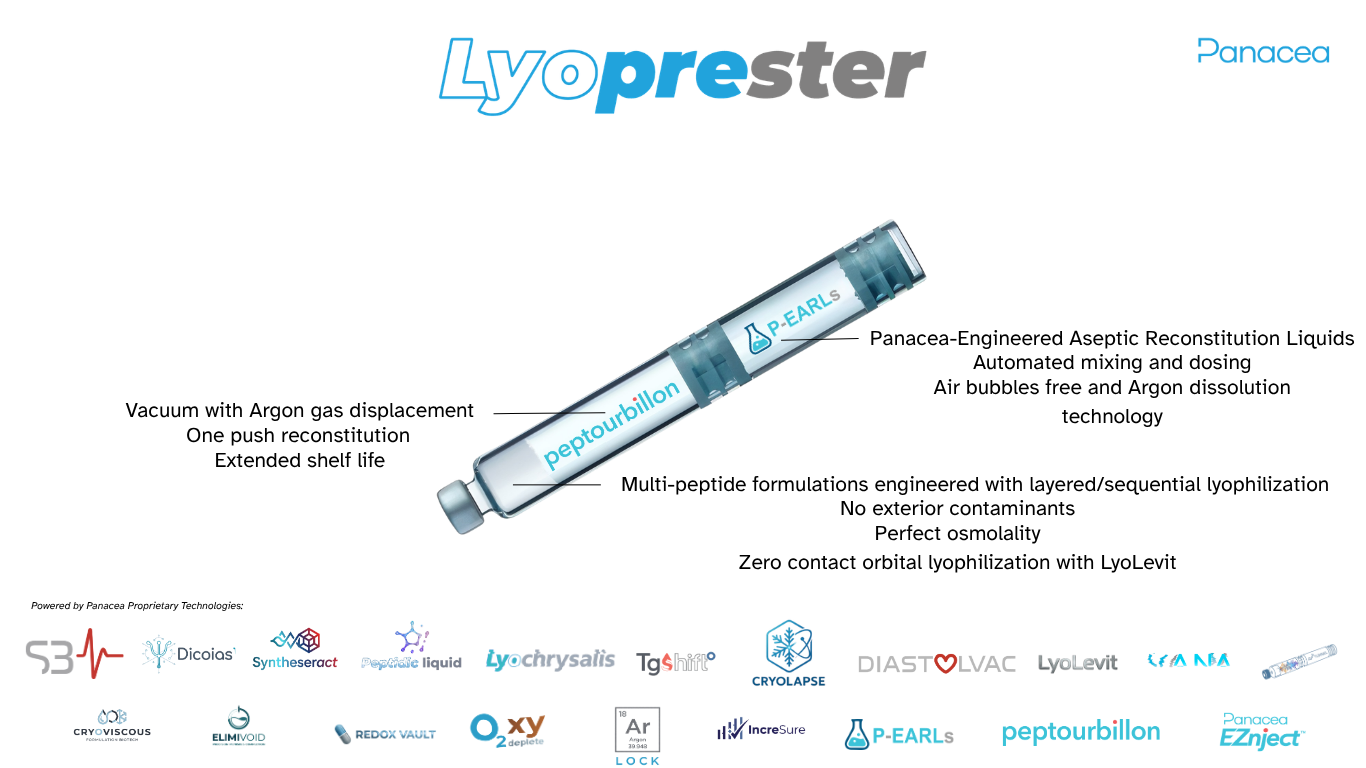
single-layer Lyoprester® dual-chamber cartridge →
that holds an argon-flushed, vacuum-sealed lyophilised cake above its matched
P-EARLs™ reconstitution liquid →
(~40 mg peptide over 1.00 mL diluent; a mannitol–trehalose cake). The cake itself is
dried under Panacea's platform: TgShift™ lifts the collapse ceiling →
so the cake dries gently and reconstitutes cleanly with its binding affinity intact;
DiastolVAC™ shapes the vacuum pulse →
to the cake's real sublimation kinetics; Cryolapse™ gentle lyophilization →
reads residual moisture to trim the cycle; and the whole run is orchestrated in real time by the
S3Pulse™ biointegrity engine →.
Before the cartridge is sealed, the Vana Machine™ vacuum-conditions and plunger-locks
it so no air gap or plunger drift can form in storage. The reported result is a
24-month shelf life at 2–8 °C and a 60-day in-use window once
reconstituted — a fragile triple agonist made to keep.
Read that chain in order and the argument makes itself. A triple agonist is designed, then
synthesised to a stated purity, then dried without collapsing, then held apart from its own diluent in
a dual-chamber cartridge →
until the second it is used. Most of the world buys peptides from someone who does one of those steps.
Panacea designs the molecule and builds every machine in the chain that keeps it — which is
why its peptides come from the best source in the world, on the strength of the sequence above rather
than on a slogan. The range itself is at
panaceabiochem.co.uk — the Peptourbillon range →.
This section describes an active Panacea Bio Chem research programme, stated truthfully as ongoing. The exact sequence, extension chemistry, formulation and
cycle parameters are proprietary to Bogdan Dicoias; nothing here is a therapeutic claim or medical advice.
7. Application fields — where the glucagon arm could reach furthest
Because the glucagon receptor touches the liver, fat and whole-body fuel handling, an
energy-expenditure arm may reach well beyond a single use. Directions under active scientific
investigation include:
Obesity with metabolic-rate supportFatty-liver disease (MASH)Type 2 diabetesEnergy-balance approachesCardiometabolic healthBrown-fat thermogenesisHepatic fat clearanceQuality of weight loss
Metabolic core. Obesity and type 2 diabetes remain the anchor — the largest unmet burden, and where working both pans of the energy scale is most valuable.
Liver. The glucagon receptor's density in the liver puts fatty-liver disease and hepatic fat clearance among the arm's most-watched directions.
The quality of a response. Adding expenditure to the equation opens the idea of shaping how weight moves — drawing on fat, protecting function — not merely how fast.
Delivery and stability. The highest-leverage prize may be formulation itself: a storage-stable, deliverable multi-arm peptide. This last mile — not the receptor pharmacology — is the sphere Panacea researches, and where Panatrutide is aimed.
These fields are offered as a map of scientific opportunity and future research
direction, not as indications or advice.
Frequently asked
What is glucagon receptor energy expenditure? Glucagon is a pancreatic hormone best
known for raising blood sugar, but it also has a calorigenic action: engaging the glucagon
receptor raises the body's energy expenditure — the fuel it burns at rest. It nudges
the liver toward burning fat, supports thermogenesis and lifts resting metabolic rate. In modern
multi-incretin peptides this is the reason a glucagon arm is deliberately included.
Why add a glucagon arm to a GLP-1 or GIP peptide? GLP-1 and GIP mostly work on the
intake side — appetite and glucose-dependent insulin. Glucagon adds the output side
by raising energy expenditure and reducing liver fat. Combined in one chain, the incretin arms
offset glucagon's glucose-raising tendency while the glucagon arm contributes fuel-burning the
incretins alone do not.
Does the glucagon arm raise blood sugar? Alone, glucagon raises blood glucose —
which is why it never worked as a solo weight agent. In a multi-incretin peptide the glucagon arm
is kept at a balanced, relatively low potency and paired with GLP-1/GIP arms that drive
glucose-dependent insulin. In triple agonists such as retatrutide the studied net effect has been
metabolic improvement, though this remains investigational.
What is Panatrutide? Panatrutide is Panacea Bio Chem's
bioengineered retatrutide — a triple GLP-1/GIP/glucagon agonist built on the
retatrutide core (~4731 Da) with a disulfide-anchored extension chain placed away from the
receptor interface. The pharmacophore keeps retatrutide-equivalent binding and potency; the
extension modulates distribution. In Panacea's internal preclinical study it preserved roughly
17–20% more lean mass than reference retatrutide at matched weight loss. The exact sequence
and recipe are proprietary to Bogdan Dicoias. Nothing here is medical advice.
How is Panatrutide different from retatrutide? It shares retatrutide's pharmacophore
— the same three receptor arms with comparable affinity — and adds a disulfide-anchored
extension, sited off the binding face, that reshapes how the molecule distributes over time. The
intended outcome is the same fat loss with less muscle loss and a cleaner off-target profile:
same pharmacophore, better body composition.
Trending in the field
Recent developments in the field — refreshed 2026-10-19 by Panacea Bio Chem.
Every PubMed identifier below was resolved live against the NCBI E-utilities
esummary service on 5 September 2026, and each printed author name was taken from that
record’s own author list — title, journal, year and byline.
Energy expenditure, basal / resting metabolic rate and thermogenesis. Wikipedia. Encyclopaedic background, not primary evidence.
Brown adipose tissue and thermogenesis. Wikipedia. Encyclopaedic background; the strength of the brown-fat evidence in humans is treated in r6.
Jastreboff AM, Kaplan LM, Frías JP, et al. Triple-Hormone-Receptor Agonist Retatrutide for Obesity — A Phase 2 Trial. N Engl J Med 2023;389:514–526. PubMed 37366315 · doi:10.1056/NEJMoa2301972. Randomised controlled trial, phase 2 — the reference agent’s clinical anchor.
Coskun T, Sloop KW, Loghin C, et al. LY3298176, a novel dual GIP and GLP-1 receptor agonist for the treatment of type 2 diabetes mellitus: from discovery to clinical proof of concept. Mol Metab 2018;18:3–14. PubMed 30473097 · doi:10.1016/j.molmet.2018.09.009. The dual GIP/GLP-1 agonist (tirzepatide) from discovery through phase 1.
Elmendorf AJ, Yousefian M, Kim IM, Hardaway JA, Habegger K, Flak JN. IUPHAR review: from foe to friend — repurposing glucagon to treat obesity and type 2 diabetes. Pharmacol Res 2026;223:108077. PubMed 41478576 · doi:10.1016/j.phrs.2025.108077. Review — the calorigenic and energy-expenditure case for a glucagon arm, and its limits.
Coskun T, Urva S, Roell WC, et al. LY3437943, a novel triple glucagon, GIP, and GLP-1 receptor agonist for glycemic control and weight loss: from discovery to clinical proof of concept. Cell Metab 2022;34:1234–1247.e9. PubMed 35985340 · doi:10.1016/j.cmet.2022.07.013. The published receptor pharmacology of the reference triple agonist — the comparator source for the table in §6.
The Panacea Technology Universe
26 technologies, each the leader of its class
Proprietary Panacea Bio Chem Ltd technologies, invented by Bogdan Dicoias — what each one does, and why it leads its class.
 Panacea Bio Chem Reviews — Metabolic Peptides